

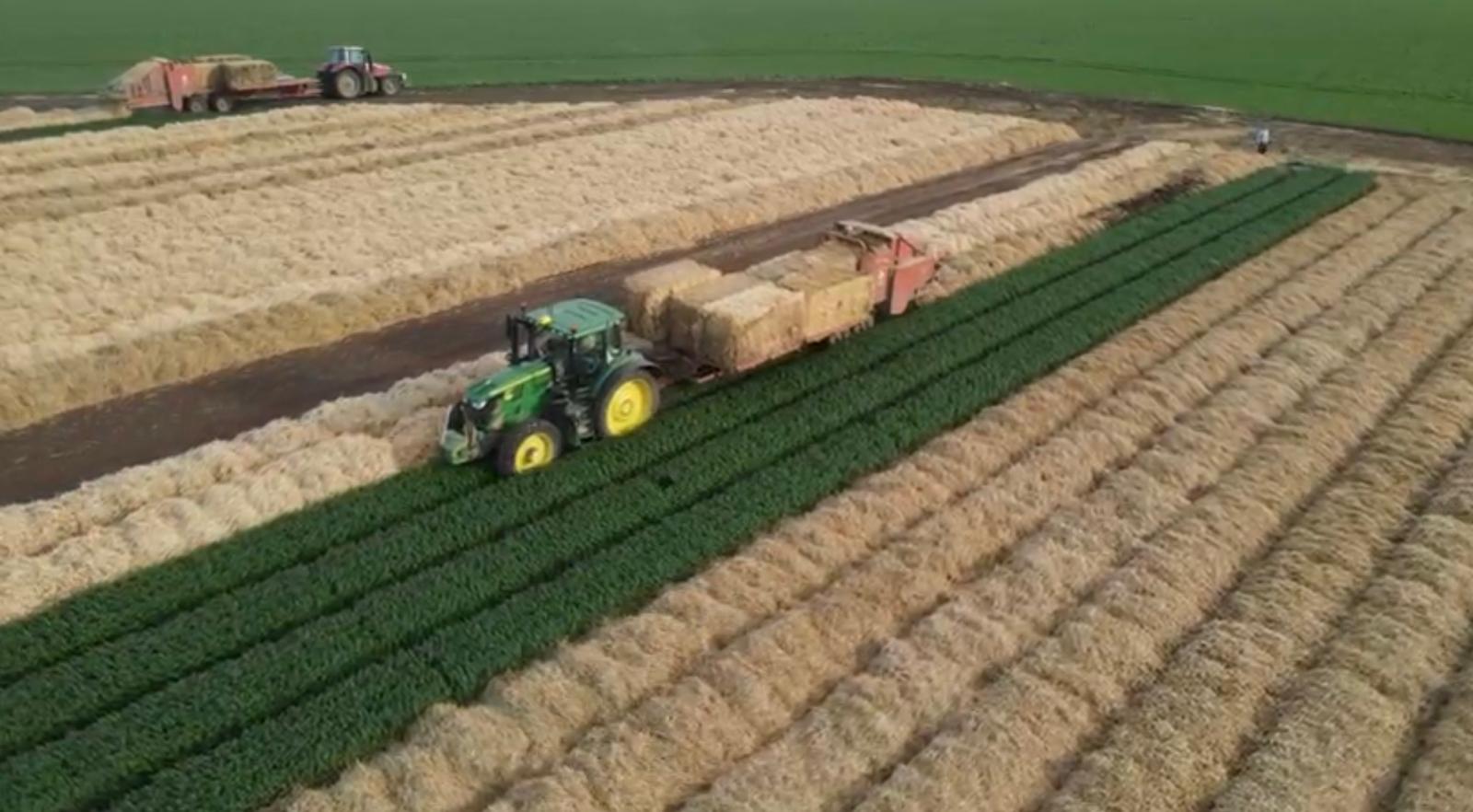
The final bales have now been spread at Hobson Farming putting 320 acres of carrots to bed for the winter months. Rodger has been undertaking this practice yearly since the late 1990s, when the demand for the number of carrots increased as well as the appetite for them out of season.
“We cover our carrots with straw to ensure we are able to offer a year-round supply to our customers.”
Storing carrots in the ground is the best way to keep them fresh and maintain quality, unlike potatoes and onions which can be harvested and put into stores before the winter. To protect the carrots from potential winter frosts we cover a third of our crop with a thick layer of straw which acts as insulation.
Deciding which third of our crop to straw is one of the most important annual decisions we make as a business. As these will be the fields, we harvest latest in the season (from February to June) they must be the best quality and have a viable yield. To gain this insight we carry out a thorough sampling of all our remaining fields in September prior to straw laying starting in early October.
This year we have found huge differences in the yields between fields due to the exceptionally dry summer. Those which got plenty of irrigation are a good size but those which suffered due to irrigation restrictions are extremely small. Some virgin carrot land fields that we would have hoped to straw due to low disease risk were simply not viable due to low yield caused by the drought. Thanks to our team’s incredible hard work this summer irrigating day and night we have managed to find enough good quality carrots to make up our strawing acreage in what has been a very challenging year of carrot growing.
We usually start laying straw at the beginning of October but this year as it has been such a dry summer we started a week later to give the carrots as much growing time as possible. Pushing the start date back any later though would risk exposure to the first frosts or fields becoming too wet to straw if we had a significant amount of rainfall.
To insulate 320 acres of carrots well enough to protect them from frost requires a lot of straw. We spread 35 big Heston bales per acre of carrots so this year we needed just over 11,000 bales. The scale of our arable farming side of the business now means that we are around 70% self-sufficient in the straw we need. The remaining 30% is sourced from local trusted farms by Martin Hawkswell who along with Rodger and Andy co-ordinate our straw laying operation.
“We have worked with Martin for over 30 years. His passion and dedication is infectious. His team do an excellent job.”
From the point of field selection, it takes Martin and his team approximately a week and a half to move all the straw into the ideal locations for each field. Martin runs two teams of four in the field who are responsible for driving the straw layers, loading the straw layers, cutting the bands and hand checking the coverage. In addition, he usually has a further three transtackers bringing straw to the field. Martin and his team aim to straw around 15 acres per day which means from start to finish straw laying usually takes about twenty-one working days.
It is an impressive operation to watch as a field of green slowly turns golden yellow one carrot bed at a time. Seven big Heston bales (weighing in at around 600 kilogrammes each) are loaded on each straw layer. Each bale in turn is fed into a rotor at the back of the machine which breaks up the bales, fluffing up the straw to keep in as much air and therefore insulation as possible, and lays it on the carrot bed. Both the tractor and straw layer have GPS guidance to prevent the machinery nipping the edges of the bed and damaging the carrots.
This year although straw yields were low due to the summer drought, straw quality has been very good as it was all baled dry therefore spreads well and gives great coverage. Ground conditions throughout October have also been exceptionally dry so fields have travelled well, allowing Martins team to straw more acres per day than in a wetter autumn.
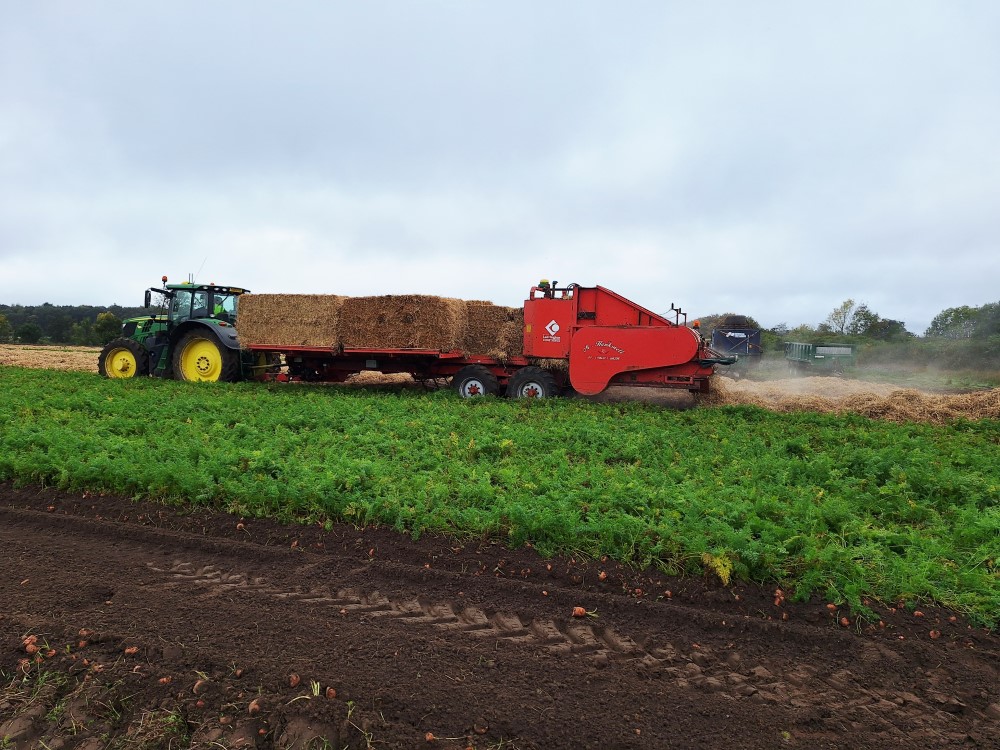
The straw stays on the carrots throughout the full winter of weather; snow, rain and frost. When it is time to harvest the carrots, the straw removing machine picks up the straw, chops it up and spreads it evenly across the field adding organic matter back into the soil. This means nothing is wasted and the soil structure of the fields is improved at the same time.
Storing carrots under straw over-winter doubles the growing costs making it the most expensive job we do. However, it is well worth it as these carrots are still cheaper than those sourced abroad, fresher and have a lower carbon footprint.